A HAWAII TRIBUNE-HERALD article initially published in Hilo, Hawaii as the lead of the Gardening/Home section on Christmas Day, December 25, 2002.
Reproduced with the permission of editor David Bock
Story by Alan McNarie
Photos by William Ing

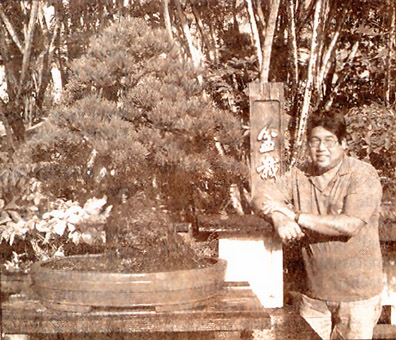
"Most of my friends are in their 80's," muses David Fukumoto. "They're in the World War II generation, and they're dying out. As they pass away, it's been my job to promote and honor them . . . and to quietly provide the resources to promote and share the art of Hawaiian bonsai."
Fukumoto and his wife, Myrtle, began doing bonsai --- the art of growing and sculpting miniature trees and plants --- in their Honolulu apartment in 1962. Thirty years ago, they moved to the Big Island and founded Fuku-Bonsai, which pioneered commercial "True Indoor Bonsai" that could survive in houseplant environments. Today their company's nursery on Olaa Road, near Kurtistown, also plays host to the Mid-Pacific Bonsai Foundation's Hawaii State Bonsai Repository, where the living treasures created by bonsai masters can "come to live" after their original owners have passed away.
The Fuku-Bonsai Cultural Center's free exhibit area now holds now over more than 200 such "pots" (A bonsai pot may contain a single tree, or it may contain a whole collection, arranged in a miniature landscape in the "Saikei" style).
But curating a collection of bonsai is far different from managing an ordinary gallery. Bonsai is, after all, living art. A bonsai sculpture keeps growing and changing, even after it leaves the hands of its original master. Those caring for the collection must learn what they can of the bonsai master's original intentions and styling for his or her piece and honor them in shaping the plant's continued growth. But they also have to honor the plant's own growth patterns and needs. Occasionally a plant must be "restyled" taking in ways that honor both the plant and the plant's original master.
The art of bonsai itself is also growing and evolving nearly as fast as the trees are --- and another purpose of the center is to honor and foster this continued growth. Bonsai as an art form has been practiced in Hawaii for about 125 years. It has existed in Japan for 1,500 years, and its ancestral art form, Chinese penjing was practiced at least a thousand years earlier. But Fukumoto notes that in the half-century since World War II, the art form as evolved rapidly, taking whole new directions --- and that one major center of that evolution has been Hawaii.
A perfect example of the evolution is the outdoor gallery's very first exhibit; a piece called "Hui Hanalike" featuring a spectacular Dwarf Schefflera trained into the form of a miniature banyan tree. Nothing could look further from a traditional Japanese bonsai, which usually features a spare evergreen with its branches trained into distinct tiers, reminiscent of natural pines that grow in mountainous environments. "Hui Hanalike" is spreading, horizontal, and lushly, unabashedly tropical.
"I learned all 5,000 Japanese rules (for bonsai), notes Fukumoto. But those rules, he says, simply don't describe the tropical forms all around him. So when bonsai became a Hawaiian art form, the rules had to change. Fukumoto and other bonsai masters borrowed some techniques and concepts from Chinese penjing, which emphasizes creativity and individuality --- "pure art" Fukumoto characterizes it, as opposed to the "pure craft" of rule-bound Japanese bonsai --- and mixed in a generous dose of American inventiveness.
Larger pieces such as "Hui Hanalike," for instance, are mounted on turntables so all sides can receive an equal amount of sunlight. And they took their inspiration from the shapes of Hawaii's native and introduced flora, such as the banyans.
"Hui Hanalike" characterizes another aspect of bonsai's evolution in Hawaii. The piece's name means "many hands working together" or "a group working together." The piece was assembled in 1986 from cuttings rooted in 1976 with the help of Fuku-Bonsai's entire staff. Many of the bonsai on exhibit inside the center's open-air gallery were developed with similar cooperative efforts, directed by a master who shared his techniques with others.
In (ancient) Japan, bonsai masters usually took their secrets to their graves. But Hawaii's bonsai community has developed a culture of open sharing, allowing each generation to build on the achievements of the last one.
The result has been an enormous variety of new forms and innovations, as displayed in the center's exhibits.
There are traditional Japanese bonsai pots, some of them imported from Japan in the aftermath of World War II, when relatively wealthy Hawaii was seen as an ideal market for the war-ravaged country's high-quality bonsai pottery. There are complex Saikei landscapes --- another postwar innovation, pioneered by Japanese master Toshio Kawamoto and Hawaii's Tom Yamamoto.
"By using a lot of rocks and small cuttings, and putting them together artistically, they could get a very attractive bonsai in a relatively short time," explains Fukumoto.
Hawaiian bonsai artists have adopted locally grown trees from Schefflera to Ironwood to actual banyans, into miniaturized forms. Some of the forms are mind-bogglingly surreal. A 50-60 year old prostrate juniper, trained by former Hilo master Jackson Kansako, in which the majority of the foliage grows well below the level of the roots, is only a presage of things to come. In one bonsai the original base of the tree stands atop a column of roots, with nearly all of the foliage below it --- "all roots and branches, with no trunk," notes Fukumoto. Another piece has living trunks bent into several archways.
The Big Island's porous volcanic stone also plays a major creative part in some of these pieces. In one, a large rock that suggested a Hawaiian god to the original master has grown into an abstract sumo wrestler, with one bonsai shrub swelling into an outsized belly and another into an outsized behind.
The bonsai master's job is to take such forms, inherent in the stone and trees, enhance and exaggerate them.
"They say that a real bonsai man is a kind of a mischievous person," observes Fukumoto. "A good bonsai is not what it appears to be. It's a kind of magic."
The center's goal is to perpetuate that magic, both by preserving the masterworks of the past and by training Hawaii's fifth generation of bonsai artists, with its continuing workshops on the art.
Fuku-Bonsai's Web site, www.fukubonsai.com, has become not only a promotional tool for the company's export plants, but also a repository of knowledge about bonsai lore, philosophy and techniques.
A good community takes care of its senior citizens as well as its youth," observes Fukumoto, "and that's indicative of what the bonsai community represents, because we nurture our old trees, but we also celebrate the exciting young bonsai."