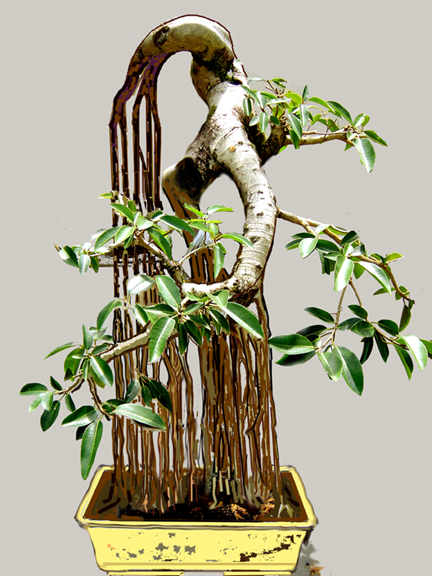
| Senior plant manager Michael Imaino joined Fuku-Bonsai in 1983 and has become the curator of the Fuku-Bonsai exhibit collection and the Hawaii State Bonsai Repository, a director of Fuku-Bonsai Inc., and the president of the non-profit Mid-Pacific Bonsai Foundation. Michael is leading the training of a unique Port Jackson Fig (Ficus rubiginosa) that was propagated from a cutting in 1983, the same year Michael joined Fuku-Bonsai. It had been grown in about 8"-12" of media on top of a plastic sheet barrier since 1992. For a detailed report of how the tree got to this stage, go to: www.fukubonsai.com/1a6.html The following is a summary of the work done to date: | |
![]() |
|
![]() |
At the end of the workshop overly long growth was removed and the ends sealed with petroleum jelly. Plywood and a plastic sheet supports and protects the root system raised up about 12" above the lowest part of the main trunk. In the back, a gallon can that had top and bottom removed and the side slit serves as a temporary dam to hold media covering the cut end of the large root. The tree is secured tightly as any shaking will damage new roots. The tree had been in the ground for nine years, longer than planned and it had gotten larger than desired. |
![]() |
|
![]() |
It was decided to lift the base of the trunk to create a more exciting
future design. Edison is watering it down with a gentle spray and
this photo allows viewing the other side. Which side will be the
front? We don't know and all effort is to create an exciting tree
that will be interesting from any side!
NOTE: Even at this very early stage of training, it was recognized that the base of the trunk and the major roots were going to form the basis for the future shape. By lifting those portions and allowing more media below, strong root growth was encouraged. |
![]() |
III. JUNE 8, 2002 Eight months after the previous training session, sixteen months after digging up the tree, and about 19 years after we began a 3" rooted cutting, we began the third training session again on another Bonsai Day at the Fuku-Bonsai Cultural Center. The training continued under Mike's lead with Edison Yadao and Cliff Tanaka assisting. |
![]() |
During this third major training session, it was realized that the long
"elephant trunk-like trunk" was so heavy that it would be very
difficult to obtain a suitable pot. It was decided to lift up the
base of the tree so the "elephant trunk" would be almost
vertical as that would allow a reasonable size square or
rectangular pot. When the session over, there's a nice feeling of success. But it's
hard to smile as we still had to move it to it's growing-on location AND
IT'S HEAVY!
|
For the next four years, the tree was allow to grow wild. Two years into this period, sections of the "box-tower" began to be removed. Sections of 6" diameter plastic pipe was sawed so two pieces could be taped together to form a cylinder for the roots to continue to grow. Black plastic sheet was wrapped around the roots. A new wood support frame support the tower of roots. During the four years, we had no idea of how many roots had developed.
A MAJOR NEW STYLING CONCEPT
The Fuku-Bonsai Cultural Center is a public bonsai collection and as such, the bonsai tend to be older and larger. This tree was pre-trained prior to being ground-planted to create a heavier tree. But things got hectic and by the time we were able to dig it up it had grown a lot more than planned! Even by standing it up to fit into a smaller pot, it was still huge. But then we noticed that the bottom part of the tree which was farthest from the roots had begun to grow more slowly. Leaves became smaller and growth was more compact compared to the parts nearer to the roots.
We began to notice that if the heavy "elephant trunk" section was removed, that we'd have a more interesting attractive tree and that we'd have an easier time obtaining a suitable pot. We discussed it for the next six months and when the decision was finally made, Michael set some air-layers to salvage the compact sections.
![]() |
IV. MAY 13, 2006
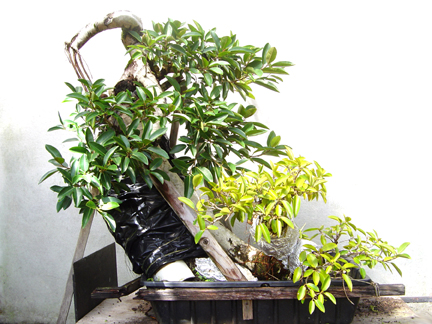
BEFORE: View of left side: Notice that the parts of the tree nearest the roots are growing vigorously with large dark green leaves while the lower section have smaller compact growth. If trees grow unevenly, prune the portion of the tree that is growing vigorously more often and the other parts will catch up. |
![]() |
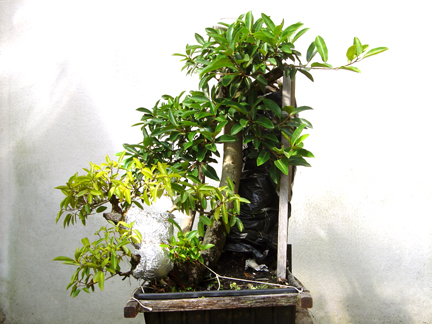
BEFORE; View of front: The tree was growing very strongly and the large elephant trunk continued to thicken to about 5" in diameter! The weight of the trunk was tilting the tree. The support was beginning to fail and the tree was twisting and threatened to topple! The new branches on the upper section have developed well but there's really no way to disguise or improve that long "elephant trunk." |
![]() |
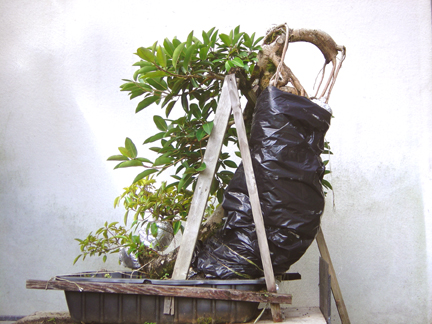
BEFORE: View of right side: The tree was really off-balance and with the weight of the "elephant trunk" it was going to take a very long time before the roots became strong enough to hold up the tree. More and more it seemed that the "elephant trunk" has got to go. So air-layers were placed on the lower sections and a few months later it was time for a major styling session! |
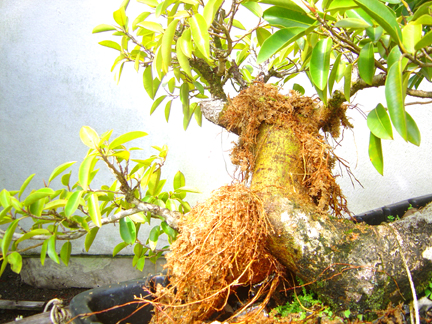
![]() |
The photo shows a large number of roots had developed. Three different air-layers were made. The original tree will become a large bonsai and perhaps the removed sections will be planted together as part of a rocky landscape companion accent one day. |
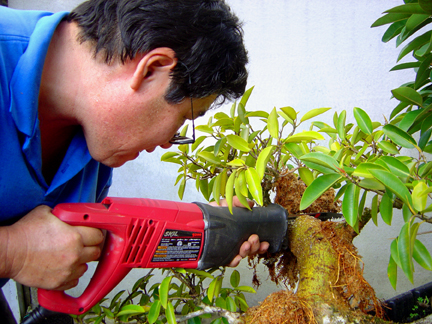
![]() |
Michael removed the first air-layer and in just a few minutes all three were removed. |
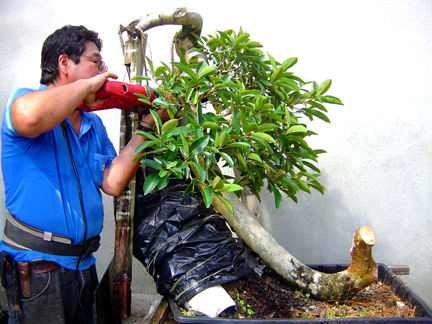
![]() |
With the support braces still on, Michael cut through and removed the elephant trunk section. |
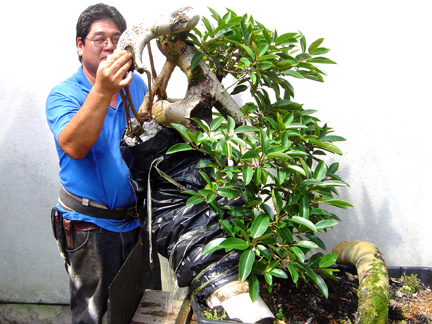
![]() |
With the supports removed, it was necessary to hold the tree up as it was leaning over a lot. Note the "elephant trunk" section removed lying across the bottom of the container measuring about 5" in diameter. |
![]() |
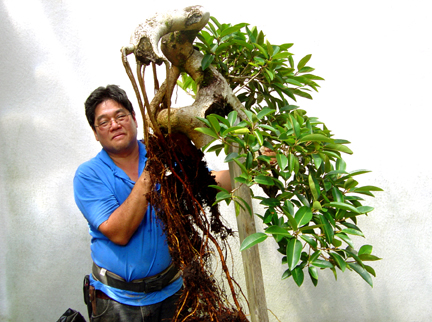
Michael holds the tree up near to the planned height with the help of a
2x3 wood support. At this point, the roots are much smaller than needed
and after realizing it will take a number of years, a sturdier support
system was constructed.
We considered styling the tree as a more traditional tropical cascade in a deep round pot but opted to strive for a tree with a dramatic shape and story. |
![]() |
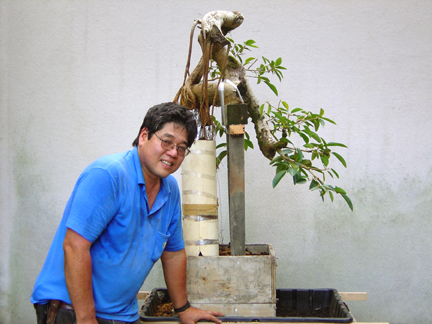
The supporting container consists of two pier block forms in a 2'x3'x8" deep plastic tub. The bulk of the weight of the tree sits on a two-legged 2x3 support with the roots primarily inside two 6" diameter plastic pipes that had been previously slit for easy future removal. |
|
THE STORY & THE NAME . . . |
"HUMILITY!" is now 23 years in training and it may take another twenty years or more before the roots become strong enough to hold up the tree. Bonsai are like people. Each person is a unique individual that is the sum of his or her genes, environment and the accumulation of life experiences. A handful of bonsai trees have unique shapes created with non-traditional plant stock that may have begun as an accident or an unusual idea.
In the past 50 years, Hawaiian bonsai has drastically changed. The first and second generation used traditional Japanese trees and followed Japanese single apex-tier branched structures. My third generation began more extensive training of tropical bonsai trees in tropical tree forms. We studied especially the banyan trees and the Fuku-Bonsai Logo Tree and the Entry Tree represent these efforts.
At Fuku-Bonsai, our collection is large and there is a standard that with the exception of memorial trees in the Hawaii State Bonsai Repository and trees that have an educational purpose, there can be only one tree of a plant variety on each "style." This guide encouraged the study of Chinese penjing and a full exploration of tropical styling. Trees with unique potential are very rare and if it happens that we have two outstanding trees of the same plant variety and same style, under our guidelines one has to be made available for trade, or for sale. The alternative is to create a "sub-style" or a unique new style!