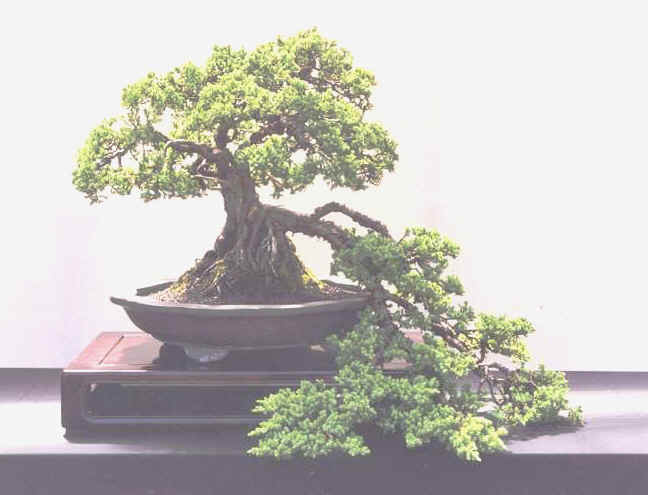
- JACKSON KANSAKO &
- DWARF PROSTRATE JUNIPER
- (MPBF #____-____)
-
-
Jackson Kansako was a
"thinking man's bonsai man!" Unlike the great majority who enjoyed bonsai
as a casual hobby, Jackson really studied. He was a school principal before he
retired and Hilo tour buses that had extra time took a detour and stopped so visitors
could admire his beautiful Japanese garden that incorporated natural lava formations and
set off by a well maintained lawn. I first met him in 1962, shortly after
Myrt and I had moved into our Kaneohe home (in a Honolulu suburb). We had flown
over to the Big Island and when the family learned we were getting interested in
bonsai, they insisted that we meet Jackson.
-
-
Jackson was a no-nonsense type. He wasn't old, but he wasn't willing to do
things that took a lot of years. He could afford to purchase almost any bonsai or
bonsai stock offered for sale and was always looking for the best possible plants.
He enjoyed drastically restyling old bonsai that others already considered " trained
winners." He had a large collection with many exciting trees in training.
He shared with me the secret of his success.
-
-
"If you want to create outstanding large bonsai, start
with well selected outstanding large bonsai stock! Young boring bonsai stock
generally will take many years of training with the likelihood of being old boring
bonsai!"
-
-
That made sense!
In those days, the Honolulu gang were relatively conservative in their training
methods and the day spent with Jackson started me on a totally different bonsai
path. By coincidence, ten years later when I moved to the Big Island,
Jackson moved to Honolulu to live with his son and most of his best trees went with
him. He joined the Hawaii Bonsai Association and played a large role in
introducing a more aggressive bonsai philosophy. One day, out of the blue,
the word went out to the top bonsai hobbyists that Jackson was dispersing his
collection. The prices were a very token amount and less than the cost of the large
beautiful ceramic pots. It was obvious that he wanted to place his best trees into
the collections of those who could maintain them.
-
-
The Hawaii State Bonsai Repository includes two trees that were styled by Jackson.
One first went to the Haruo Kaneshiro collection. The second (described and
photographed below) went to the Ted Tsukiyama collection and later donated by Ted in
Jackson's memory.
-
-
Dwarf Prostrate Juniper (Juniperous squamata 'Prostrata') was introduced to Hawaii after
World War II, probably in the late 1940's as the economy picked up. It is
likely that these arrived as bareroot rooted cuttings so the oldest are likely to be 45 to
50 years old. I began training and propagating Dwarf Prostrate Juniper from about
1965 and this bonsai is clearly older than the others in our collection. When the
tree was initially donated, it wasn't in great health as there's more spider mite
problems in dry Honolulu. But when it got back to the Big Island, in a larger
pot and under the skilled care of Fuku-Bonsai plant manager Michael Imaino, growth
exploded!
-
-
October 1999 photo. The distinctive long lowest cascading branch
especially has developed well and the crown has filled out. The long-term strategy
is to slant the tree to the left and to continue to build up the right side,
including development of transitional growth between the crown and the dominant cascading
branch.
-
-
This is the tree that
best represents the spirit and philosophy of the Hawaii State Bonsai Repository.
We're the fourth to have the responsibility of caring for this tree. It has changed
hands quietly and each time, the shape has improved. It has never been sold
for more than a small fraction of its market value, and that's the reason it
survives. There's a general rule amongst the knowledgeable bonsai community that if
bonsai are sold at market value, it's likely that the trees will not long
survive. That's because those who can afford to pay the highest prices generally
have the least amount of skill.
-
-
This juniper has Hawaiian historical bonsai significance and Ted Tsukiyama donated it to
keep it in the public domain, to allow future bonsai growers and visitors to study
and enjoy it, and to honor the memory of our friend Jackson Kansako!
-
- *** Return to Index
*** Continue to next section
*** Go to
Mail-order section
- November 1999
www.FUKUBONSAI.COM
© Fuku-Bonsai