- THE AMAZING HAWAIIAN MICRO-LOBSTERS!™
- MAIL-ORDER SECTION
PRODUCT INFORMATION

PRODUCT INFORMATION |
|
When we began, we recommended keeping our units in low light as algae would grow on the tank walls in bright light. Because we feed spirulina, it is not necessary to grow algae. Algae grows when the lights are on so we included cleaner sticks. As research began to suggest that there is increased reproduction when fed more aggressively and with a 12-hour light on-off schedule, we began to explore ways to make our units "crash-proof!"
MOST PEOPLE TEND TO OVER-FEED! They enjoy feeding their pets and watching them filter-feed on the surface. Two incidents in May and June of 2005 led to exploring FIRST AID? Can we prevent a crash! and a follow-up article "CRASH-PROOFING" Breeder tank modification to prevent crashing (even if you tend to over-feed and keep the unit well-lit)! These are two major articles that are highly recommended reading.
The addition of air is a major step toward installing an optimum environment utilizing standard aquarium techniques. But I needed to explore one more major element, namely incorporating snails. I had tried to stay away from this area as I knew this was an area that governmental regulators are very uncomfortable with. There is a number of pros and cons and there are few, if any, experts. I believe that I and the regulators are now comfortable and we will begin including pipipi into our larger breeding tanks.
|
|
|
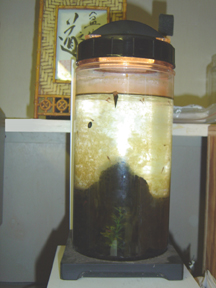
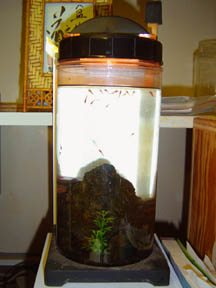
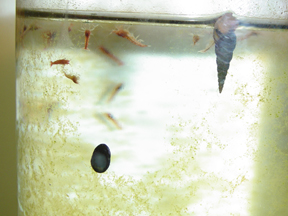
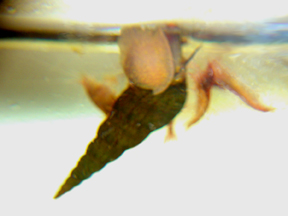
| BEFORE AT THE START OF THE TRIAL. The larger, longer pointed snail is the Polynesian Taro Snail. The round one is pipipi. | AFTER THREE WEEKS THE TANK IS CRYSTAL CLEAR! The Micro-Lobsters are active and the snails are cleaning up any old leftovers. "Crash-proof" without air? |
To prepare for this set of trials, I kept the light on my 3/4-gallon Educational Breeder Tank on 24-hours per day for several weeks to allow a dense amount of algae to form. The unit is raised to the same height as my computer screen and this is the unit I observe the most and where I've made a number of the photos that are used on this website and in this essay. It's the first BT-2 Educational Breeder Tank prototype put together in the summer of 2003 and now over two years. Population began with 36 Micro-Lobsters which is close to the equilibrium density (the point where reproduction is just enough to replace those that die of old age). From time to time I spot one or two post-larval juveniles but most are adult size and population is estimated at about 40.
 |
TWO SNAIL FINALISTS. After extensive research and input by David Chai, Thomas Iwai, Mike Yamamoto, Alton Miyasaka, John Hoover, and Cory Pittman, the two finalists were the endemic Hawaiian marine "pipipi" also known as the Black Nerite (Nerita picea) and the Malaysian Livebearer or Polynesian Taro Snail (Melanoides tuberculata). From the start, pipipi was everyone's favorite as it has a cute shape, is a very effective glass cleaning algae eater, and is widely available on most Hawaiian rocky shorelines. |
 |
Cory originally nominated Melanoides tuberculata and it initially scared
everyone, including Cory, as this snail is unique. Each is a livebearing female that can
reproduce without a male. It is a widely distributed freshwater snail
with the ability to survive 30 ppt salinity which is almost ocean
water! In Florida, someone counted 38,000 in a single square
meter!
The snail is believed to have been brought to Hawaii by the original Polynesians aboard their voyaging canoes in the mud around the taro corms and is widely distributed throughout the tropical waters of the world. It primarily eats dead leaves and detritus, burrowing through the substrate during the day and visible on the tank walls at night. |
|
Within two weeks, the first two babies were spotted on the tank walls.
Opae'ula are less than 1/2" long so the baby snail is between 1/16" and 1/8" long. The ability to proliferate has given this
snail a bad reputation as a possible pest. It could be a valuable snail
to remove detritus and to aerate the substrate to prevent anaerobic
conditions that produce toxic hydrogen sulfide gas. It will not greatly reproduce unless there is an abundance of
food. If
the populations explode, it would prevent a crash so this would be a
plus. But at this
point, Hawaii regulators will not allow Fuku-Bonsai to ship this snail
although it is found throughout the world and we will be removing the
Polynesian Taro Snails in all except two test tanks where we will
continue to collect data.
|
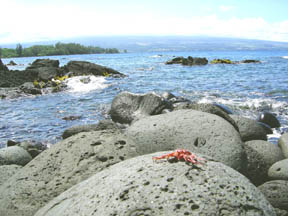 |
INTRODUCING PIPIPI! Pipipi is probably the most common marine snail in Hawaii and it is preferred by regulators as it is far less likely to become a pest. It has been approved for inclusion into our breeding tanks including for entry into Japan, Canada, and other foreign countries. As a tropical marine snail, it has the ability to live in brackish water but will not likely live in fresh water nor in temperate climates. It's abundant along any rocky shoreline in Hawaii. This photo is of Hilo Bay where a sun-baked red Ama Crab sits atop a lava ocean boulder that have been smoothed by the waves. In the background in 13,000' cloud-covered Mauna Kea and the city of Hilo. |
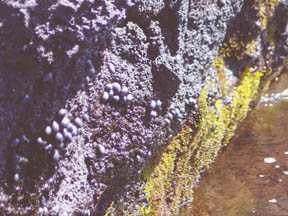 |
The largest pipipi is almost 1/2" and these are found in abundance on rocky shores above the splash zone. As kids we collected the largest ones. Our parents would boil them and with a safety pin, we would extract them as they have a delicious abalone-like taste. Our regulators advise if you ever get too many to consider eating the excess, although they are not expected to proliferate in the tanks. Large pipipi tend to sit in groups above the water. Pipipi are able to grow their shells and believed to live for 6 years or so. When they die, hermit crabs take over their shells. Pipipi have larger relatives known by the Hawaiian name Kupe-e (Nerita polita) that may grow larger to 1 1/2" and is prized for eating. |
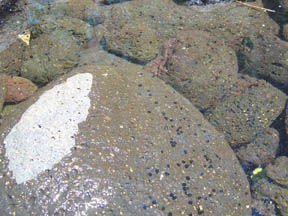 |
The ones most suitable for keeping the opae'ula tanks clean are the smaller ones that measure about 1/8" to 1/4" as these tend to stay in the water. The photo shows the large numbers amongst the wave smoothed round rocks. Fuku-Bonsai is authorized to include these into our opae'ula tanks as part of being a Hawaii Department of Land and Natural Resources licensed aquaculture facility. |
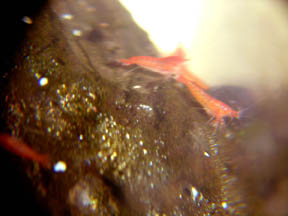 |
In Micro-Lobster units, pipipi tend to lay eggs that appear to be white spots about 1/16" across on the black lava aquascape or lava gravel. Some are scattered across the rocks while others are clustered closer together. In nature, when the eggs hatch, the snail larvae drift in the ocean and come back to shore to become juvenile snails as shown in the above photo. There is no record yet as to whether these will reproduce in our tanks. |
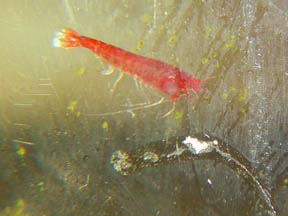 |
The photo shows the "eating path" of a pipipi and the egg cluster that is about 1/6" across. This was taken as the tank was cleaning up as the pipipi was still removing algae from the tank walls. Since the photo was taken, the pipipi has made several more passes and the tank wall is much cleaner and there is a crystal clear view of the aquascape. |
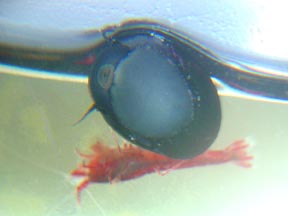 |
Like abalone, they cruise and keep the tanks free of algae. The pipipi is doing a great job as a clean-up crew. We plan to include one pipipi in each 1/2-gallon BT-1D Mini-Breeder Tank and 2 in each 3/4-gallon BT-2 Educational Breeder Tank. In the larger units being planned, we will likely include one pipipi for each 1/2-gallon so a 5-gallon unit will have 10 pipipi. |
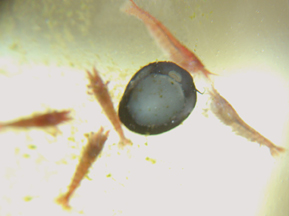 |
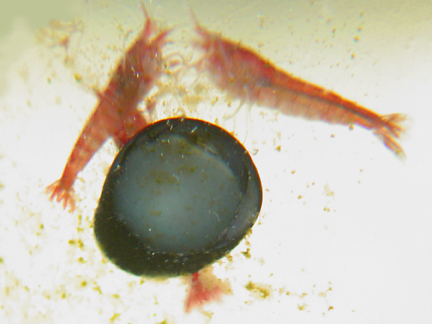
During the first week or so when the pipipi was first placed into the tank, the opae'ula was curious about the new tank mate and were often visiting it and I was able to take a number of these photos. It is apparent that opae'ula and pipipi are very compatible. |
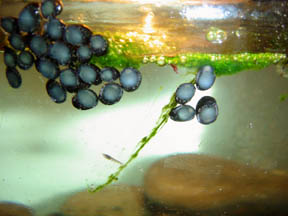 |
Besides eating whatever algae grows on the rocks and tank walls we feed about a teaspoon or so of fresh live filamentous algae daily from our algae tanks. The actual amount of algae added is according to the amount being eaten and there is always some algae visible. Pipipi are voracious eaters and will die if there is not enough to eat. The holding tank has some 1" to 4" flattish river rocks and about 20 opae'ula swimming around to add interest. |
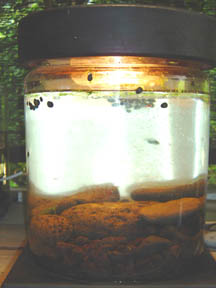 |
The "Pipipi Holding Tank" is a 2-gallon heavy glass jar that
is also a part of the educational exhibit in the "Micro-Lobster
Museum" that Fuku-Bonsai Cultural Center visitors can enjoy.
Increasingly, center visitors are coming to see the opae'ula exhibits in
addition to the bonsai collection. The tank includes an air stone
and a 20-watt halogen lamp that is left on all the time as we try to
grow algae.
Michael created an attractive light cover with a special light enclosure that is vented to allow the heat from the Halogen light to escape but does not allow the larger pipipi out. Without this device, the larger pipipi were climbing out and we would find some on the floor! The combination of the air stone, halogen lamp, river rocks, opae'ula, and pipipi makes this holding tank an attractive exhibit item. |
Although these are very common in Hawaii, some customers that learned of them would rather purchase them. It's a real hassle to supply a person with just one and a concern that that one might not survive and acclimate. So the initial price is 2 for $3. But shipping via postal is $5. There will be no shipping fee if there is a purchase of a Micro-Lobster unit or a True Indoor Bonsai. For more information, please contact David W. Fukumoto
- TECHNICAL UPDATE!
- By Cory Pittman, August 7, 2006; photos courtesy of Cory Pittman
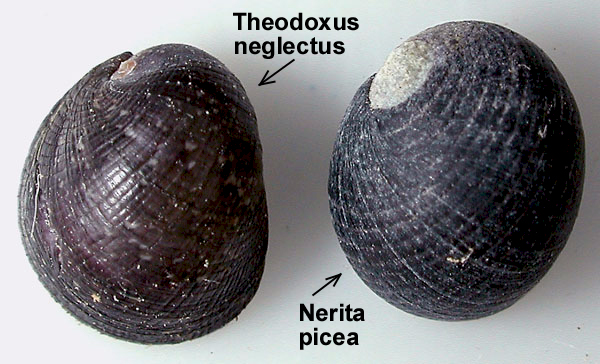
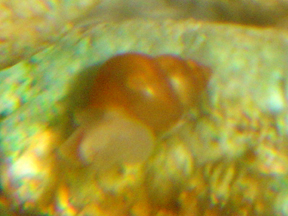
"You state that the snails you're shipping as "pipipi" are Nerita picea. However, as far as I can tell, the snails in your closeup photos and the second field shot are Theodoxus neglectus (while the photo of nerites on the algae-covered boulder shows Nerita picea). Both of these species are nerites and they are very similar in appearance. Also, both are referred to commonly as "pipipi" and eaten as such. However, their behavior is quite different. Nerita picea lives in clusters on rocks and logs in the high intertidal, remains out of water at low tide and often feeds when out of the water (if damp/shaded).
On the other hand, Theodoxus neglectus lives slightly lower in the intertidal, usually stays under rocks or in tide pools during low tide and, generally, only feeds when in water. The former tends to be larger and when you state that "Interestingly, the largest ones tend to end up on the covers of the tanks and the smallest ones seem to be the most effective and most often doing their work." I suspect that you are confusing the two species.
I'm attaching two photos comparing similar-sized shells of the two species with Theodoxus neglectus on the left and Nerita picea on the right. As you can see, the former has much fainter spiral striae, more teeth on the inner lip, faint white spotting, a slightly more flattened form and other subtle differences. As I believe you've discovered, Theodoxus neglectus is likely to be a better species for your purposes. And, I thought it might be good to straighten out the identity of the snails you're shipping in order prevent future regulatory problems or confusion on the part of the purchasers.
I just remembered that, although a lot of people are still using "Theodoxus neglectus," the species has been moved to the genus Clithon. So, that would make the preferred name for your snails "Clithon neglectus."
_______________________________________________________________
I mentioned to Cory that some customers are reporting that the pipipi die quickly while others have excellent results. Cory thinks we may be collecting both Theodoxus (Clithon) neglectus and Nerita picea. We will try using a magnifying glass to separate and may one day be sufficiently expert to tell them apart!
In providing Cory an update on the various DNA studies being conducted by Scott Santos, I mentioned that the Oahu lineage had "bands" and their habitats were the solution holes in uplifted fossilized reefs. Because of this, I created a carved coral aquascape with coral chips from Hilo Bay and somehow a tiny unknown snail had gotten in and was slowly increasing. Cory thought he would be able to identify it if I sent photos and he did!
_______________________________________________________________
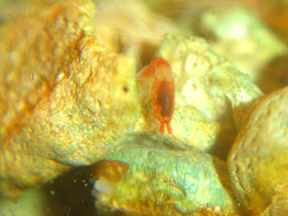
The unidentified snail is to the left and in front of the Oahu "red and pale banded" opae'ula. Fully grown ones are about 1/8" long with very slow reproduction rate. Yes, the unknown snail is Assiminea sp. It's interesting that it's successfully reproducing in your tank. If I'd been asked to speculate, I would have guessed that it wouldn't since other species in the genus have free-swimming veliger larvae. Perhaps the Assiminea sp. is an exception. Or, perhaps the veligers either settle rapidly or don't require much volume, something that would make sense if it's surviving in some anchialine ponds...
Cory wrote: The unknown snail is Assiminea nitida as illustrated in Kay's Hawaiian Marine Shells (1979). However, I just did a quick search and it appears that Richard Cowie synonymized A. nitida with A. parvula in 1998 based on material from Samoa. But, I gather there's also some question about whether the Hawaiian population is the same as the Samoan. So, perhaps it's safer to just say "Assiminea sp.". :-)
_______________________________________________________________
Such is the world of the experts where serious academic battles rage on and laymen try to make sense out of it all! I'm not sure if we'll ever become expert enough to be able to spot the difference between the two pipipi species, but it's good to know that one tends to climb out of tanks while the other stays underwater. We've been approached by marine aquarium hobbyists seeking "pipipi" and while we won't supply them, caution that there are two very similar species and that one will do the job while the other won't. That's important information! Cory, much mahalo for the update, corrections, and clarifications! ~~~David :-)
We are continuing research on plants, snails and other creatures of the anchialine ponds. For a follow-up on the above original article, go to www.fukubonsai.com/M-L1n1.html