- THE AMAZING HAWAIIAN MICRO-LOBSTERS!™
- SAM GON'S PAGE
Opae-ula has been available in Hawaii for several years and some hobbyists have been growing them for longer than us. We're sharing what we know with everyone and learning from the old-timers.

|
|
|
 |
I first learned of Sam Gon from John
Pescador of Honolulu who wrote to compliment the Micro-Lobster website. He wrote of
his interest and recommended I contact his teacher Sam and allowed use of photos from his
website.
|
 |
|
UPDATED HONOLULU TRIP REPORT
On November 12, 2004 I had the pleasure of visiting Dr. Sam Gon III to observe his opae-ula tank. Other researchers have had opae-ula tanks in their laboratories but to my knowledge none have allowed publishing photos of them. I'm told that if tanks are clear and do not have hiding places, that the opae-ula will not reproduce in tanks. Sam's tank is over 10 years and producing steadily.
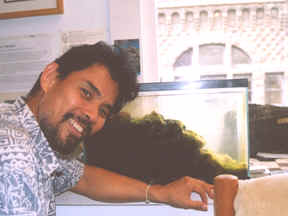 |
Meet Dr. Sam Gon III! For a fellow that has built an impressive
reputation, he turned out to be much younger than I thought, but
clearly a serious person who is knowledgeable in a wide range of
subjects. When I visited he was in the midst of some submittal deadlines
but took the time to answer my questions.
His tank has the characteristics of other 1/2 to 1 gallon researcher jars but was much larger. He provides a lot of light to be able to produce enough algae so there is enough food. |
 |
There
was one warmer very bright corner and on the opposite side there was a
cooler darker corner. This has been the only tank that I've seen these
factors and it really makes sense! Newly hatched larvae tended to
cluster in the brightest corner. I had an clear plastic cube and
was able to collect and observe the newly hatch larvae with the 5x
jeweler's loupe.
Sam's opae-ula were originally collected in an Ewa sinkhole and is of the type that I call "banded opae-ula" as some of them have white bands crossing red bodies and including other color variations. |
 |
Sam has opae-ula collected from many locations and in jars of various
sizes throughout The Nature Conservancy of Hawaii 3-story building. He
allows a heavy amount of algae and notes that different algae types
form. He also notes that there is a spurt of reproduction in a new
unit and slowing down when it attains a natural balance.
He tells me Honolulu water does not have chlorine so he uses tap water allowed to stand a day or so to bring the water level of his tanks back up to offset evaporation. |
I thank John Pescador for introducing me (via email) to Sam Gon and Sam for his willingness to share his knowledge. Sam has been involved in opae-ula and anchialine pond surveys and know that Sam's group discovered that opae-ula had colonized the Sailor's Cap blast crater on Kahoolawe created when the military detonated 500 tons of explosives in 1965. There are very limited fresh water resources on that island and the pool water has almost the same salinity as the ocean. This suggests that opae-ula may one day be discovered in marine conditions in the reefs or ocean floor rubble.
Opae-ula research is progressing very rapidly due to the aloha spirit of people like Sam and John. They've created a lot more leads and along with members of the Fuku-Bonsai Micro-Lobster Team, we're getting a greater insight into opae-ula. They really are amazing creatures!
Right now the anchialine pools are being compromised by alien predator fish being introduced and this forces the opae-ula to retreat into the subterranean habitat. Although they are not in danger of becoming extinct, they are becoming less and less accessible. The information being shared are part of the research to design and construct a large scale captive breeding mass culture system as this is perceived to be the primary future source of opae-ula if fish continue to be introduced into the anchialine pools or if it becomes illegal to collect from the pools. The key is to develop and obtain support for sustainable harvesting of anchialine ponds to provide the needed quantities of broodstock needed for the captive breeding mass culture systems! Stay tuned! ~~~David