| All of us who live on the Big Island do so because we think it is a
very special place. Costs are very high as goods travel cross-country, over an ocean, then
inter-island. Often the cost of shipping an item is much more that the actual
Mainland cost! Export companies must consider the cost of shipping our goods to the
mainland market because customers are looking at their total costs including
shipping. Between these two costs, profit margins are slim. The Big Island is
not a place to get rich by producing export products!
We live here because we value the lifestyle, the warm and generous people
ready to help each other, who live frugal, quiet lives and because of the community's
old-fashioned integrity values and mutual support.
"HAM" & TRADITIONAL BIG
ISLAND BONSAI!
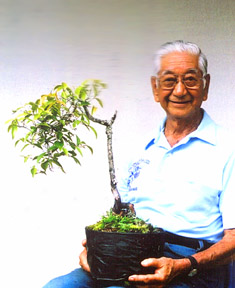
An important member of our community is Isamu "Ham" Kaneshiro, a retired
insurance agent that everyone runs into at just about everywhere. His nickname
"Ham" comes from his ham radio hobby which has made him friends throughout the
world. And perhaps that's why his children are scattered about and why his life has
dramatically changed since he lost his wife.
In Hawaii State, the Big Island probably had the highest per capita number of bonsai
growers because of the casual lifestyle and the inspiration of uncluttered natural
beauty. It's still a paradise for those who enjoy collecting trees as the thin soil
over rocky lava produce the finest bonsai stock. Almost everyone knows how to grow
seedlings or to root cuttings and these are freely distributed amongst the extended bonsai
family. The Big Island is not a place for a professional bonsai grower to get rich!
One segment of the bonsai community pays homage to traditional bonsai and religiously
train tropical trees into the Japanese codified pine tree shapes. These gatherings
allow a local bonsai expert to hold court and in return, the assembled group are treated
to refreshments and an opportunity to gather. Such social activities were once
common in the rural plantation towns but have been fading away. Waimea Bonyu Kai is
the Big Island's oldest bonsai club and their name literally translates into the Waimea
Friendship Club. While friendship is clearly their priority, their members produce
outstanding bonsai!
Ham is one of our senior Big Island "village story-tellers" and talks of his
brother Jinsei who was amongst the oldest bonsai sensei with a twist. Rather than
follow prescribed Japanese bonsai practices, he wove into his classes a common sense
Hawaiian philosophy of life. He took a traditional bonsai shape and
"intentionally-accidentally" broke the "wrong" branch. After giving
the audience some time to think about it, he launched into a parable of life message that
he had prepared. "What are you going to do?" "Accidents
happen!" "What can you do?" And for the rest of the class he answered
those questions and created new forms of bonsai.
OKINAWAN HISTORICAL BACKGROUND
Many Okinawans don't consider themselves Japanese as the Ryukyu Kingdom was already
established in the 1100's. They annually sent to China tributes of sulfur which was
mixed with niter and charcoal to create gunpowder. The valuable tributes resulted in
free and favored trade with the internationally dominant Chinese. Throughout
the 15th and 16th century, "Wako" pirate-mercenaries travelling in groups
of more than 20 ships loaded with over 2,000 men and many war horses attacked the coastal
villages of China, Korea, Thailand, Vietnam, etc. The Wako were made up of both Japanese
and Chinese and although they the entire region was terrorized, Okinawa and Okinawan ships
were never attacked.
In 1609,
Okinawa was invaded by the Japanese forces and extracted trade privileges and the northern
Okinawan Islands. In 1872, Japan militarily annexed Okinawa and the Ryukyu Kingdom
ended. China did not recognize the annexation and while tensions continued to build
between Japan and China, the status of Okinawa was not clear.
A short time
later in 1900 Okinawans began streaming into Hawaii to provide needed labor for the sugar
plantations. At one time, Japanese were vegetarians and looked down upon the "eta"
that handled unclean animals. Okinawan culture is similar to Chinese and both made
generous use of pork. Poorly treated by the Japanese, they worked hard and built an
extraordinary mutual assistance society with deep regional and family loyalties that
endure.
HAM
& THE HAWAIIAN-OKINAWAN COMMUNITY
Even when I was
growing up in the 1940's in Hawaii, there was prejudice against Okinawans. But their food
was delicious and a large number of the most popular restaurants in Hawaii are owned and
operated by Okinawan families. Okinawans have the longest life expectancy in the world!
Their method of multiple cooking of pork makes it tasty and easy to digest.
Bitter melon has been cited as part of their longevity secret. But many believe it's
due to their positive and cooperative outlook on life.
World War II was a tragic time for the Okinawans as they were sacrificed and used as
cannon fodder in the Battle of Okinawa. Over 25% of the entire civilian population
of Okinawa were killed or forced to commit suicide. The war ended with surrender after the
dropping of the atomic bombs on Hiroshima and Nagasaki. Although historical
revisionists claim it was cruel inhumanity, conventional warfare would have taken many
more lives if an invasion of the Japanese mainland was necessary. As such, the Japanese
mainland was spared the total devastation of Okinawa.
Hawaii's Okinawan community rallied to send food, money, and old clothes. After the
relief ships ended, there were severe shortages and items were just not available in
Okinawa. Items were sent even though postage costs were much more than the cost of the
goods being sent. The Hawaiian Okinawan community sent a shipload of pigs in an
effort to help rebuild the agricultural economy and there is a strong bond of friendship
between Okinawa and Hawaii.
It took the relief effort to unite the Hawaiian Okinawan community and soon after,
"Hui Hanalike" (Hawaiian for "a group that works together") was
formed. The unregistered name had been used for many years, but the name was registered by
another group. The name was changed to Hui Okinawa. It's an outstanding
group that enjoys wide community support and a reputation for community events with great
food!
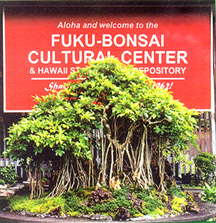
THE FUKU-BONSAI OKINAWAN CONNECTION
I had the good fortune of marrying into the Higa and Kiyabu families and without the
support and goodwill of the Okinawan community, Fuku-Bonsai would not have began nor
survived. Okinawan names are prominent in our company. Past Hawaii County mayor
Herbert Matayoshi and past director Kiyotsugu Oshiro challenged us to create the finest
bonsai center and became early stockholders. Past director Conrad Hokama and Carolyn
Oki (wife of current corporate secretary Wallace Oki) are past presidents of Hui
Okinawa. Shizuko Akamine is a member of the Okinawan Cultural Center board and
active in Okinawan dance and teaching koto.
Okinawans have also been the most prominent in Hawaiian bonsai history. During World
War II when bonsai was abandoned, Soboku Nishihira collected them and hid them in the
forest reserve above Hilo. The oldest bonsai came to Hilo as gifts from the Japanese
Maritime training ships in the late 1800's and early 1900's before the 1919 Quarantine Act
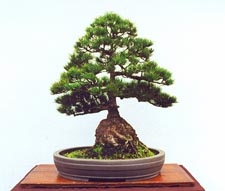
that prohibited Japanese Black Pines and other two-needle pines. Since then, Hawaiian pine
bonsai have been mainly grown from seeds.
After the war, Nishihara brought down the trees and opened the first bonsai
nursery. He is widely credited for having the courage to preserve these old trees
and many ended up in the legendary Watanabe, Yonehara, Geise, Kansako, and Hirota
collections. His home was also frequently visited by Haruo "Papa"
Kaneshiro, then a cook on the inter-island Young Brothers barge. "Papa"
learned bonsai from Nishihira and is affectionately acknowledged as the "The Father
of Hawaiian Tropical Bonsai." He was one of my teachers and Fuku-Bonsai
strongly reflects his Okinawan cultural values.
ALOHA HAM KANESHIRO!
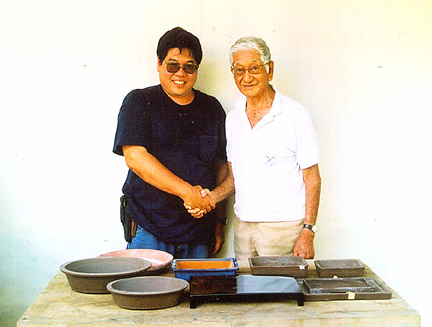
Ham and Mid-Pacific Bonsai Foundation
president Michael Imaino at his last visit in which he donated bonsai pots and display
stands to the Foundation. October 7, 2003
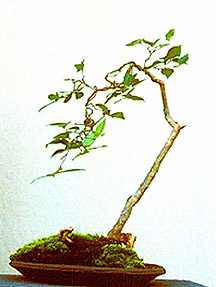
Ham has been a good friend of many years. A year or two ago I suspected that something was
brewing when he came over and donated a unique Surinam Cherry bonsai with extraordinary
potential. We talked a lot and I added more detail to my knowledge of the Big
Island and Okinawan communities. The donation of a second Weeping Banyan was his
"excuse" to visit again and we had another long talk. As promised he mailed me
printed information about Hui Okinawa's history.
On his latest visit Ham donated empty bonsai pots and a bonsai display stand to the
Foundation and informed us that he will be heading for Las Vegas to live with his
son. Ham is healthy and is fortunate to have a wonderful family. Our community
is losing a truly wonderful person and I hope that in writing parts of his stories
that it shares some of the richness that he's shared with us! We're sad but our loss
is Las Vegas' gain. We hope everyone there will welcome and bring him into the
Hawaiian and Okinawan ohanas!
Aloha and mahalo Ham! ~~~David W. Fukumoto (November 21, 2003) |