|
|
|
|
In Japan, bonsai was said to once have been passed down within the family through generations. While it has a romantic appeal and attraction, the realities of modern American life makes this very unlikely as very few children are interested, willing, or able to take over a family bonsai collection. Trees are usually sold or given away. Generally, if the sale is open to the public and sold at the highest prices, it likely will go to those with limited skills and the bonsai will soon be dead.
Those in the bonsai community has recognized this and often the best bonsai are first offered to a select group of bonsai friends for token amounts or given to them as gifts. There's a growing custom amongst the top Hawaiian bonsai growers that bonsai that were received as gifts are passed on to others as gifts and not sold. If the collection is large, individuals or clubs may assist in organizing bonsai sales, setting prices, and inviting specific clubs or individuals.
In 1986, the Mid-Pacific Bonsai Foundation was formed to compliment the proposed Fuku-Bonsai activities and public bonsai collection. It co-sponsored the Hawaii State Bonsai Repository to keep specific bonsai in the public domain. Beginning with the bonsai donated by the family of Sadakichi Sugahara, the repository has steadily grown to include a number of memorial bonsai to honor past Hawaiian bonsai grower-trainers.
It includes trees trained by prominently known bonsai grower-trainers at Fuku-Bonsai or in major bonsai conventions or demonstrations. The impressive list includes Haruo "Papa" Kaneshiro, Saburo Kato, Shinji Ogasawara, John Naka, Tom Yamamoto, Pius Notter, and others. This section will continue to enlarge to include photos and stories of the trees in the Hawaii State Bonsai Repository.
We begin with the newest addition, a Chinese Banyan that had been partially trained and donated by Mid-Pacific Bonsai Foundation's president emeritus Hiroshi Ikeda. When donated, the tree was pot-bound in a cement pot, but was already too large for Hiroshi's bad back to handle. It was a high potential plant with a very impressive root system that could be styled in either of two different concepts. To prepare it for training, it was removed from the pot and all possible soil removed. The tree was pruned to preserve branches suitable for either of the two major styling concepts. Roots were selected, pruned and rearranged. With a larger nursery pot and fresh media, the tree immediately greatly increased its vigor.
Part of the concept of the Hawaii State Bonsai Repository is to show the widest possible range of styling. But in addition to those associated with Fuku-Bonsai and the Foundation, from time to time, guest trainers are invited to train trees. While there is input from all present, the guest trainer makes the styling decisions. He or she is invited to continue to be involved with the future training.
Jerry Meislik recently published FICUS, THE EXOTIC BONSAI, the most comprehensive book on growing ficus as bonsai. Ficus are tropical trees and Jerry lives in Whitefish, Montana very near to the Canadian border. While it would seem to be an impossible place to grow ficus, he's created an extraordinary environment with metal halide lamps as reported in a previous Fuku-Bonsai website article. Jerry is associated with Fuku-Bonsai as a stockholder and correspondent and has visited previously. His story has been enhanced by his computer graphics skill that illustrate possible future styling. Which way will he train if the future? Stay tuned!
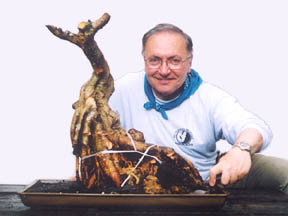 |
The Training of "MAHALO!" by Jerry Meislik (May 2004) A photo sequence report with a follow-up titled: "The Future of Mahalo!" and a book review of Ficus, the Exotic Bonsai. |
- *** Return to www.FUKUBONSAI.COM Home Page
- *** Return to MID-PACIFIC BONSAI FOUNDATION Home Page
